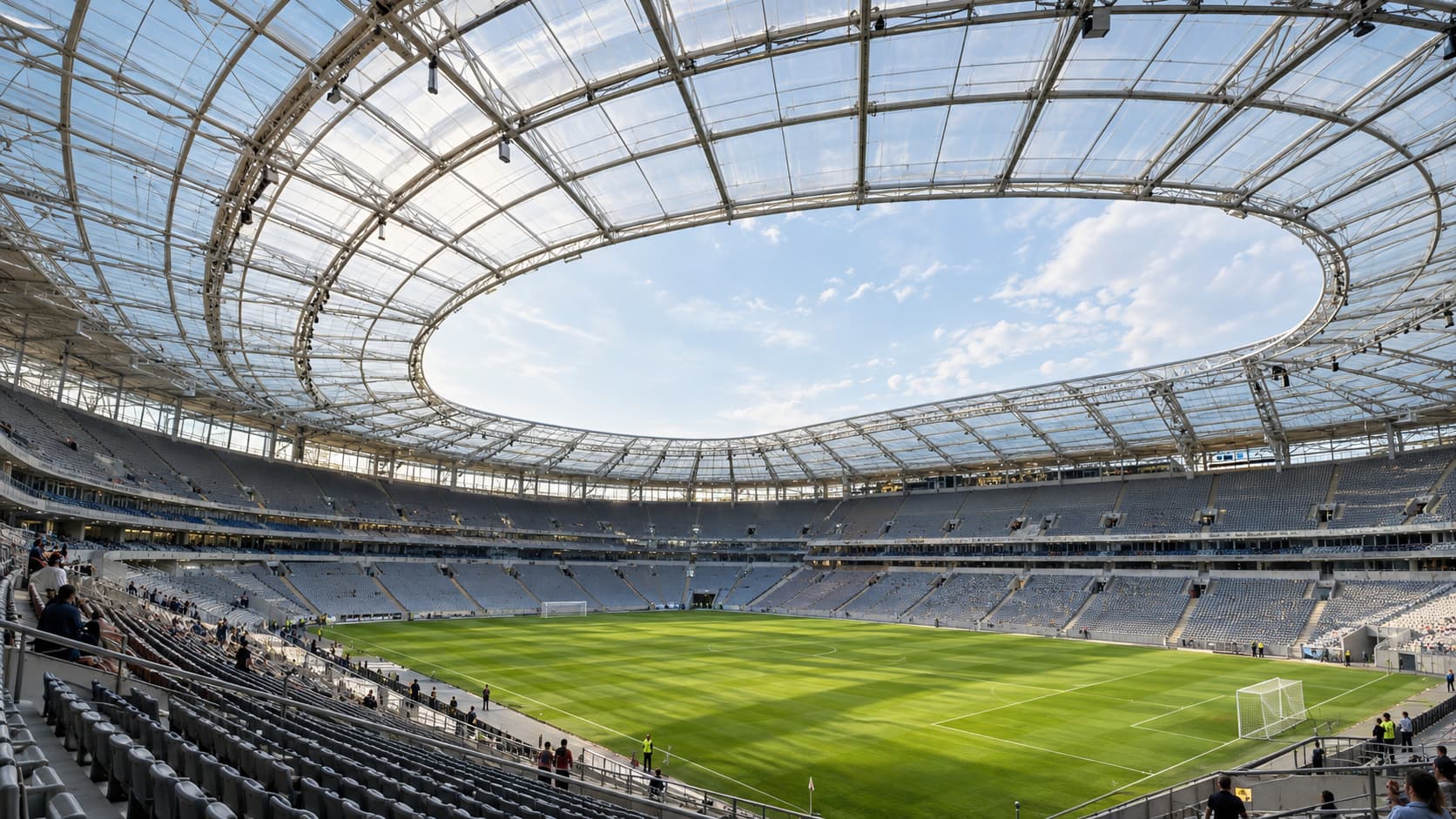
Modern stadium roofs no longer need to block out the sky. Ethylene tetrafluoroethylene (ETFE), a lightweight fluoropolymer used in architectural membranes, allows designers to create enormous roof structures that admit natural daylight while protecting spectators from rain, snow, and wind. The best-known example is Munich’s Allianz Arena, opened in 2005, whose facade of ETFE cushions can be lit in different colors depending on the event. In the United States, three major venues illustrate the material’s versatility: SoFi Stadium in California, U.S. Bank Stadium in Minnesota, and Allegiant Stadium in Nevada. Although all three use ETFE, their roofs respond to very different climates and engineering requirements.
ETFE as a Stadium Roofing Material
ETFE is manufactured as a thin, flexible film rather than a rigid sheet of glass. It can be installed as a single-layer membrane or assembled into multilayer cushions maintained by low-pressure air systems. The cushions provide additional thermal insulation and help the material withstand environmental loads, while single-layer installations depend on carefully designed supporting structures and membrane tension.
Its low weight is particularly valuable for stadiums, where roofs must span large distances without obstructing spectators’ views. Compared with conventional glass roofing, ETFE places considerably less dead load on the supporting framework. This can reduce the structural demands placed on beams, cables, and foundations, although the final savings depend on the entire roof design.
Transparency is another important advantage. ETFE can transmit substantial amounts of daylight, but transparent and translucent installations are not identical. Architects can apply printed patterns, coatings, or multiple layers to control glare and solar heat gain. These treatments are especially important in hot climates, where unrestricted sunlight could increase cooling demands and make seating areas uncomfortable.
The material also resists corrosion and many environmental contaminants. Its relatively low surface adhesion allows rain to remove some accumulated dirt, but claims that ETFE roofs require no cleaning are misleading. Large stadium installations still need inspection, drainage maintenance, and occasional specialist cleaning.
SoFi Stadium and Its Cable-Supported Roof
Completed in 2020, SoFi Stadium in Inglewood, California, uses one of the world’s most ambitious cable-supported stadium roofs. Designed by HKS, the canopy consists of more than 300 single-layer ETFE panels carried by a long-span cable roof structure. Unlike a conventional enclosed dome, the canopy covers an indoor-outdoor venue designed to benefit from Southern California’s relatively mild climate.
The roof includes 46 mechanized ventilation panels that can open to release accumulated warm air. This system works with the building’s open sides to encourage natural airflow, reducing reliance on conventional air conditioning within the seating bowl. The ETFE membrane also incorporates a printed reflective pattern that limits solar heat gain while allowing daylight to enter.
SoFi demonstrates how a translucent roof can become a defining architectural feature without completely enclosing the playing environment. A single-layer membrane works here because the climate is mild: the roof mainly needs to shed rain and limit heat, not insulate against freezing winters. Its lightweight film is nevertheless supported by a highly sophisticated structural system, including extensive steelwork, specialized cable connections, and seismic engineering suited to Southern California.
The canopy also carries an integrated LED display system visible from above. This feature transforms part of the roof into a media surface, showing that ETFE structures can accommodate technologies extending beyond weather protection and natural lighting.
U.S. Bank Stadium and Minnesota’s Harsh Winters
U.S. Bank Stadium in Minneapolis presents a different engineering problem. Minnesota experiences heavy snowfall, low winter temperatures, and substantial seasonal changes, making a traditional open-air arrangement impractical for a venue intended to operate throughout the year.
Opened in 2016, the stadium features a sharply sloping fixed roof with approximately 60% of its surface covered by transparent ETFE. The remaining portion uses conventional roofing materials. The transparent sections consist of three-layer pneumatic cushions that admit daylight while contributing to the thermal performance of the building envelope.
The roof’s distinctive angular shape helps manage snow accumulation and directs precipitation toward engineered drainage systems. Snow management also involves gutters and snow-melting equipment, demonstrating that a lightweight covering does not eliminate the need for robust winter infrastructure.
Large glass façades complement the transparent roof, creating the visual impression of an outdoor stadium while maintaining an enclosed, climate-controlled interior. This combination was an important architectural decision: spectators can experience natural daylight without being directly exposed to Minneapolis winter conditions.
U.S. Bank Stadium illustrates why material selection cannot be separated from climate. ETFE provides daylight and reduced structural weight, but the building still requires insulation strategies, heating, snow management, and carefully engineered support systems.
Allegiant Stadium and Climate Control in Las Vegas
Allegiant Stadium opened in Las Vegas in 2020 with a fixed ETFE roof designed for a markedly different environment. Summer temperatures frequently exceed 100°F, making solar exposure and indoor cooling central considerations.
More than 100 stainless-steel cables form a net that supports the ETFE roofing system and acts as the roof’s structural diaphragm. The roof admits natural light while maintaining a fully enclosed, temperature-controlled stadium environment. On one side, four huge steel-and-glass lanai doors frame a view of the Las Vegas Strip, although they usually remain closed during summer events because of the extreme outdoor heat. Unlike SoFi Stadium’s open-sided design, Allegiant Stadium relies on mechanical systems to regulate indoor conditions during games, concerts, and other large events.
Its environmental strategy includes high-efficiency air-handling equipment, cooling infrastructure, lighting controls, and building management systems that monitor energy use. The ETFE roof forms one component of this broader approach rather than functioning as a standalone cooling solution.
In a desert climate, controlling heat gain is just as important as admitting daylight, and the roof’s performance depends on the complete assembly of materials, geometry, and mechanical systems.
Engineering Costs and Maintenance Challenges
ETFE roofs offer advantages, but their construction requires specialized knowledge. Single-layer membranes must remain properly tensioned, while pneumatic cushions need reliable air-supply systems, monitoring equipment, and connections capable of maintaining their designed pressure. Supporting structures must accommodate wind uplift, temperature changes, rainfall, and other site-specific loads.
The membranes themselves are comparatively light, but the full installation may involve substantial engineering costs. Large-span cable networks, steel compression rings, drainage systems, access platforms, and mechanical components can account for a considerable share of the project budget. Consequently, comparing the price of ETFE film with the price of glass does not reveal the total cost of a completed roof.
Maintenance requirements also vary. Areas where rainwater cannot fully remove dirt need periodic specialist cleaning. Multilayer cushion systems require attention to air-pressure equipment and seals, while roof operators must inspect connections, drainage channels, and components affected by weather exposure. Severe weather can test even a well-designed membrane: after a 2023 hailstorm damaged parts of its roof, U.S. Bank Stadium began a partial roof replacement.
Acoustic performance is another consideration. Thin membranes behave differently from heavy conventional roofs when exposed to rain and external noise. Engineers may need additional design measures to manage sound transmission and reverberation inside large enclosed venues.
The Future of Transparent Stadium Architecture
SoFi Stadium, U.S. Bank Stadium, and Allegiant Stadium demonstrate three distinct applications of the same roofing material. California uses a vast translucent canopy with natural ventilation, Minnesota combines transparent cushions with winter protection, and Nevada integrates ETFE into a mechanically controlled indoor environment.
These examples also reveal why ETFE is not a universal replacement for conventional roofing. Its suitability depends on the local climate, building geometry, structural system, maintenance capacity, and the intended use of the venue.
For future stadium projects, the most promising approach is not simply to maximize transparency. Architects must balance daylight, spectator comfort, structural efficiency, and long-term operating costs. ETFE makes ambitious roof designs possible, but successful results depend on how intelligently the material is integrated into the entire stadium.